Thursday, 22 June 2017
Harrison Ford Called Himself A ‘Schmuck’ After Latest Plane Incident
The actor also said he was distracted in an audio recording with air traffic control.
Monday, 27 March 2017
Language acquisition
Langu
The capacity to successfully use language requires one to acquire a range of tools including phonology, morphology, syntax, semantics, and an extensive vocabulary. Language can be vocalized as in speech, or manual as in sign. Human language capacity is represented in the brain. Even though human language capacity is finite, one can say and understand an infinite number of sentences, which is based on a syntactic principle called recursion. Evidence suggests that every individual has three recursive mechanisms that allow sentences to go indeterminately.
These three mechanisms are: relativization, complementation and coordination.
Furthermore, there are actually two main guiding principles in first-language acquisition, that is, speech perception always precedes speech production and the gradually evolving system by which a child learns a language is built up one step at a time, beginning with the distinction between individual phonemes.
similarities
- In both first and second language acquisition, universal grammar may influence learning. In second language learning, universal grammar may influence learning either independently or through the first language.
- In both first and second language acquisition, there are predictable stages, and particular structures are acquired in a set order. Individuals may move more slowly or quickly through these stages, but they cannot skip ahead.
- In both first and second language acquisition, making errors is a part of learning. Learners need to make and test hypotheses about language to build an internal representation of the language. In the initial stages of learning, learners may use chunks of language without breaking them down or processing them as independent units. In later stages, they may make new errors as they begin to process the parts of each chunk according to the rules of their language system. For example, a learner may start out using the correct form of an irregular verb as part of a language chunk, but later overgeneralize and place a regular affix on that same verb.
- In both first and second language acquisition, the learner uses context clues, prior knowledge, and interaction to comprehend language.
- In both first and second language acquisition, age is an important variable affecting proficiency.
- In both first and second language acquisition, learners can often comprehend more complex language than they are able to produce. In the initial stages of learning, learners go through a silent period.
- In both first and second language acquisition, a learner's proficiency can vary across situations.
- In both first and second language acquisition, learners may overgeneralize vocabulary or rules, using them in contexts broader than those in which they should be used.
- In both first and second language acquisition, learners need comprehensible input and opportunities to learn language in context in order to increase their proficiency.
- In first language acquisition, the basis for learning is universal grammar alone. In second language acquisition, knowledge of the first language also serves as a basis for learning the second language. There may be both positive and negative transfer between languages in second language learning.
- In first language acquisition, children spend several years listening to language, babbling, and using telegraphic speech before they can form sentences. In second language acquisition in older learners, learning is more rapid and people are able to form sentences within a shorter period of time.
- In formal second language learning in older learners, learners are able to use more metacognitive processes in their learning. They can consciously analyze and manipulate grammatical structures, and they can explicitly describe how language works. This can speed the learning process.
- In second language learning in older learners, learners bring more life experience and background knowledge to their learning. They have more schemata and more learning strategies to help them learn the second language.
- In second language learning in older learners, there may be less access to universal grammar, and sensitivity to phonological distinctions not present in the native language will be reduced. Students learning in a classroom setting may also have fewer opportunities to learn language authentically. These factors may reduce the likelihood that second language learners will attain native-like proficiency. First-language learners always attain native proficiency, unless they have a disability that affects language learning.
- In first language acquistion, learners have many chances to practice with native speakers (especially caregivers). In second language acquisition, learners may or may not have the opportunity to practice extensively with native speakers.
- Almost everyone acquires a first language, but not everyone acquires a second language. Acquiring a first language happens naturally, while acquiring a second language often requires conscious effort on the part of the learner.
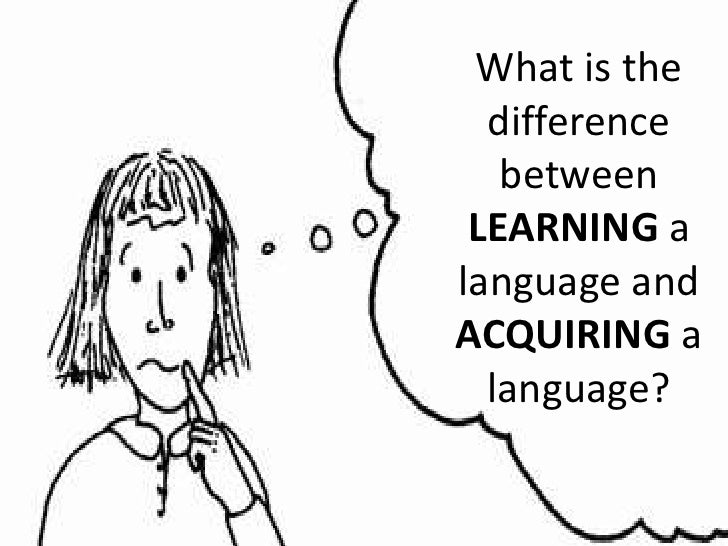
Different between Language Acquisition and Language Learning
There is an important distinction made by linguists between language
acquisition and language learning. Children acquire language through a
subconscious process during which they are unaware of grammatical
rules. This is similar to the way they acquire their first language.
They get a feel for what is and what isn’t correct. In order to acquire
language, the learner needs a source of natural communication. The
emphasis is on the text of the communication and not on the form. Young
students who are in the process of acquiring English get plenty of “on
the job” practice. They readily acquire the language to communicate
with classmates. Language learning, on the other hand, is not communicative. It is the result of direct instruction in the rules of language. And it certainly is not an age-appropriate activity for your young learners. In language learning, students have conscious knowledge of the new language and can talk about that knowledge. They can fill in the blanks on a grammar page. Research has shown, however, that knowing grammar rules does not necessarily result in good speaking or writing.r A student who has memorized the rules of the language may be able to succeed on a standardized test of English language but may not be able to speak or write correctly.
Stephen Krashen draws a big distinction between learnt and acquired language, a distinction that has caused controversy in itself, quite apart from his ideas for promoting this acquisition. According to Krashen, students who are taught in a formal, form-focussed way will “learn” the language but never fully acquire it. Acquisition, which is the basis for all L1 knowledge, consists of rules and principles that are not available to conscious attention. By contrast, learnt language can only be used as a “monitor” (a check, as it were) to what we say in L2. Krashen argues this is the only use of learnt language and further goes on to say that learnt knowledge can never become acquired knowledge. Krashen’s model has thus been termed a “dual competence” model.
We now we move onto ways in which Krashen states that this acquisition can be promoted in the un-naturalistic setting of the classroom. The crux of Krashen’s theories is that students acquire (as opposed to learn) when they are able to understand something (primarily through context) that is a little above their current level of understanding. There is no explicit focus on form such as, for example, “present perfect” (which aids only “learning”) but new language is inserted into utterances containing language already known to the students. Krashen calls this “comprehensible input” and McDonough (1995) describes it as an “accretion of knowledge from instances of incomprehension embedded in the comprehensible.”
Krashen talks about a number of ways in which students’ acquisition is made easier. Their “affective filter” should be kept low. This means their reception of input should be kept as high as possible. To this end, Krashen thinks that the students should be as relaxed as possible. Production should not be forced in any way. Students will produce when they are ready to. A high level of error correction is also seen as being bad for keeping the affective filter low. In everyday terms, a student who is too often corrected will eventually elect to just stay quiet.
Error correction, only useful for “learning”, should thus be generally avoided if acquisition is the aim of the teacher. Krashen doesn’t believe the classroom to be the place where a second language can be successfully acquired and so states that the priority in the classroom should be to equip students for real-life conversations and for real-life situations where acquisition is more likely to take place. It should be noted here that Krashen has been heavily criticised for making such a bold distinction between learning and acquisition and especially for his claim that classroom ESL teaching does little or nothing to help students acquire a language.
Differences between language learning and acquisition
There are 2 main differences. One is found in methodology, the second in psychology.
This image represents how a student typically learns a language when they go to a language class. As a former language teacher and language student I'm familiar with the drill of many types of language practice.
Normally, language practice is structured on teaching the forms of grammar considered the least complicated and the most usable in conversation. Almost immediately, people will learn to talk about the present, for example. Describing a past day follows almost shortly after.
Although in principle the idea I think is acceptable for some people, I find some problems with the nature of this style of methodology:
- Vocabulary is usually chosen in an artificial manner about what the textbook writer (or teacher if you're lucky) thinks is needed. Secondly most language teachers only focus on teaching "correct" or "proper" language rather than what is most frequently encountered. Thus I had French students who despite having learned English for over 40 years, didn't know things like "gonna" and "wanna".
- Focus on immediate production without an incubation period. Production without first learning the norms of the language gives the student no reference to work on. It is like getting a person to write a paper on macroeconomic theory having never studied economics.
While most language methods agree you need exposure to all elements in the above circle, many argue about which you do first.
This argument I believe comes down to psychology and should be treated as such. It is not in the domain of linguists.
Linguists study language structure, origins, and the interplay between language, culture and thought. But they do not study the how humans learn.
One of the first functions we develop as babies is an ability to find patterns. Through observation we learn to infer information from these patterns. It is through this ability that children learn their master language(s).
Later on at about 10 years of age, our cognitive skills develop which enable abstract thinking. The basis of the critical period hypothesis is that this cognitive dominance inhibits the ability to infer, and hence learn languages the way children do.
If this thinking sounds flawed to you. I totally agree. There is a serious lack of scientific process applied to this research. In the scientific method, to identify the influence of a single factor (like chronological age), all other variables should be kept the same if possible. In telecommunications, we used to refer to this as isolation testing.
To support the critical period hypothesis, a quality scientific study would need to use the same methodology children learn languages with adults. I have not found one study yet that does this. I've looked.
Common sense dictates that our ability to match patterns doesn't diminish either. Not if we live with our eyes open. Yet thinking persists in language (amongst other subjects) that we need to have a rule and reason for each lesson. In reality it just satisfies our brains need for a reason. It doesn't help much with gaining ability in a language though.

This picture represents language acquisition methods. A key difference is the order of the approach. Acquisition, natural, or communicative approaches focus first and foremost on providing accompanying context and environment that is conducive to inference, or "guessing" of meaning.
It is an implicit method, rather than the explicit method above that gives certain sounding rules. These rules are often comforting to adults who have a fear of uncertainty, but they are limiting as rules often only function in a restricted fashion.
Acquisition methods instead focus on the acquisition of norms as opposed to rules. Norms are rooted in the social structure of a group. In language learning, the native speakers form the 'group'. Like becoming a team member in a workplace, we need to learn the norms of the group to be in the group. Otherwise we will always be an outsider.
Acquisition methods like ALG seek to create an environment that maximizes comprehensible input and allows the student to infer meaning through observation of patterns over time. This requires the student to attempt to not analyze the language and as a result they are not allowed to take notes in class.
There is also a silent period which allows the student to identify the norms of the language before production begins. If the student hears a lot of non-native usage of the language, they become unable to differentiate what sounds normal in the target language, and what does not.
The method itself requires a leap of faith because it flies in the face of what most adults believe is "learning". In fact the process engages a very different area in our brain.
This is how people who are uneducated and often not cognitively developed (such as poverty stricken refugees from Myanmar here in Thailand) can become fluent in a new language even if they move as an adult. This doesn't happen with all, but it does with those that interact frequently with the local population (such as Burmese in service roles). For this also there is insufficient research conducted about how these groups learn languages.
Acquisition methods also may be a better way to learn vocabulary. Meredith Brinster of John Hopkins University has recently conducted research suggesting that children retain vocabulary better through inference than through explicit teaching. I'd like to see research like this done on adults.
I'm not saying that language learning doesn't work, but that it is getting the order backwards and using the wrong neural process to learn in an ideal fashion. It focuses on output before significant amounts of input are gained and not exposing the students to linguistic norms until they are advanced students. This results in the student transferring the linguistic norms of their own language onto the second one, resulting in a student that will always speak like a foreigner.
Man Sentenced To 5 Years In Prison For Taping Dog's Mouth Shut
The puppy underwent reconstructive surgery after her muzzle was painfully bound with electrical tape.
wonder touchlight

Do you have a family to protect?
If a burglar were to break into your home tonight, would you be prepared? If you're like us, the safety of you and your family is probably your #1 concern. So what do you do to keep them safe? Buy a big safe car, install a home alarm system, buy a gun? Those are all good ideas, but you can't take those with you everywhere you go. Which is why we're so excited about this new military grade tactical flashlight that's just been released. You know how after someone takes a picture of you at night with the flash on, it takes like 3 minutes to see properly again? Now imagine that flash is 100x brighter and it doesn't turn off. You'd have the ability to disorient any would be attacker with the push of a button.
That's what you get with the Gladiator Flashlights
The truth is, most people underestimate the importance of owning a great flashlight. And these days, in a world where terrorism, and natural disasters are becoming the norm, it's more important than ever to have the right tactical gear.
This light's incredible LED technology is used by the U.S. Navy Seals, the Coast Guard, Firemen, Policemen, U.S. Search and Rescue and now it's been placed inside of an amazing Flashlight called the X800...
With Over 20,000 Sold This Month, People Are Talking:
This work in a surprise way
These flashlights are currently selling for a big discount off their regular price! So make sure you hurry and grab yours now at the discounted price.World's best airports for 2017 revealed
Hamad International Airport: One to watch
French idioms
A collection of idiomatic expressions in French with English equivalents and translations.
| Idioms | English versions | ||||
|---|---|---|---|---|---|
| Faire la tête | to sulk ("to do the head") |
||||
| Garder la tête froide | to keep one's cool ("to keep the head cool") |
||||
| Se creuser la tête |
to think really hard / to try to remember something ("to dig into your head") |
||||
| Se casser la tête | to go to a lot of trouble; to worry about sb/sth ("to break your head") |
||||
| Coûter les yeux de la tête | to cost an arm and a leg ("to cost the eyes from the head") |
||||
| Se mettre le doigt dans l'œil | To put your foot in it - to make a mistake ("to put your finger in your eye") |
||||
| être bouche bée | to be open-mouthed; gapping; flabbergasted ("to be mouth open") |
||||
| être sans voix | to be speechless ("to be without voice") |
||||
| Donner sa langue au chat | to give up ("to give one's tongue to the cat") |
||||
| avoir (un mot) sur le bout de la langue | to have (a word) on the tip of your tongue | ||||
| Avoir les dent longues | to be ambitious; to have lofty goals ("to have long teeth") |
||||
| Avoir un poil dans la main | to be lazy; to avoid work ("to have a hair in the hand") |
||||
| Manger sur le pouce | to grab a bite to eat; to eat on the run ("to eat on the thumb") |
||||
| Ne rien faire de ses dix doigts | to be lazy ("to do nothing with one's ten fingers") |
||||
| Prendre ses jambes à son cou | to take to one's heels; to run away ("to take one's legs to one's neck) |
||||
| Casser les pieds à quelqu'un | to get on someone's nerves ("to break someone's feet) |
||||
| Enlever une épine du pied à quelqu'un | to help / get someone out of a fix ("to remove a thorn from someone's foot) |
||||
| Couper la poire en deux | to meet someone halfway ("to cut the pear in two") |
||||
| Pédaler dans la semoule | to go round in circles / to get nowhere fast ("to pedal in the semolina") |
||||
| Tomber dans les pommes | to faint / pass out ("to fall in the apples") |
||||
| Tondre des œufs | to be cheap / a skinflint ("to mow/crop/shear the eggs") |
||||
| Sucrer les fraises | to be a bit doddery ("to sugar the strawberries") |
||||
| C'est la goutte d'eau qui fait déborder le vase | the straw that broke the camel's back ("it's the drop of water that made the vase overflow") |
||||
| Casser du sucre sur le dos de quelqu'un | to gossip about someone behind their back ("to break some sugar on someone's back") |
||||
| Appuyer sur le champignon | to drive very fast; to accelerate; to floor it; to put the pedal to the metal ("to press on the mushroom") |
||||
| Étre dans le pétrin | to be in a mess / a jam; in serious trouble ("to be in the kneading-trough") |
||||
| avoir la tête dans le guidon | to be overwhelmed; to be striving; to be working hard ("to have one's head in the handlebars") |
||||
| mettre son grain de sel | to butt in; to put one's oar in; to make one's point ("to put one's grain of salt") |
||||
| se regarder le nombril | to be egocentric; pretentious; selfish; to think the world/universe revolves around oneself ("to gaze at your navel") |
||||
| être soupe au lait | to be quick-tempered ("to be milky soup") |
||||
| prendre la mouche | to go off in a huff ("to take the fly") |
||||
| faire mouche | to score a bull's-eye ("to do a fly/button") |
||||
| rouler à tombeau ouvert | to go at breakneck speed ("to roll with the tomb open") |
||||
| sentir le sapin | to have one foot in the grave; have a graveyard cough; be not long for this world ("to smell of fir trees") - fir is used for coffins |
||||
| (faire quelque chose avec) les doigts dans le nez | as easy as falling off a log ("[as easy as putting] one's fingers in one's nose") |
||||
| tomber de sommeil |
Latest news on transgender
Odisha MBA transgender weds man
"I salute Basudeba Nayak for taking such a bold step to marry me. Basudeba was unfazed by the social stigma attached to a transgender like me. I also prove those wrong who think a transgender person cannot marry a normal man," said Meghna in her bridal attire at Nayapally Durga Mandap. 32-year-old Basudeba, employed as a supervisor in a private security agency here, is the estranged husband of a woman, who ditched him and married another man in 2012. Basudeba, a resident of Jatni on city outskirts, has a four-year-old son.
"Since I cannot attain motherhood, I will treat Basudeba's child as my own son. We three will stay in Bhubaneswar," said Meghna, who currently works as a journalist with a vernacular weekly paper. Meghna said she underwent sex change four years ago.
Basudeba said he came in contact with Meghna on Facebook a year ago. "I told Meghna about my family discord. I also discussed with my family members and relatives after I decided to marry Meghna. I do not find anything weird in marrying the transgender person. The Supreme Court recently gave the transgender a special identity in the society. I am not worried about general perceptions of public," said Basudeba.
People of all walks of life, including members of lesbian, gay, bisexual and transgender (LGBT) community and mayor A N Jena attended the wedding ceremony. Family members of Meghna and relatives of the groom were also present.
Meghna's father Jaya Krushna Sahoo, who stays at Bharatpur on city outskirts, said he gave consent for the marriage. "Meghna was born like a boy. I have two other sons. But we witnessed gender-related abnormality with him around 10 years ago. Meghna left home and settled in Bhubaneswar. She chose social activism. Basudeba earlier this month approached me with the marriage proposal. I agreed," said Sahoo, a driver and small businessman.
4 members of transgender gang held for robbery on highways
The accused were identified as Sonu alias Sonia from Sadabad, Satendra Singh alias Rupali from Hathras, Shamsuddin alias Dolly from Mathura and Chotu alias Priya from Hathras
Talking to mediapersons at Itmad-ud Daulah police station, circle officer of Chhatta, BS Tyagi, said that the four accused were nabbed from Rambagh bridge on Wednesday.
Transgender power celebrated at IIM-B Prayaas Day
Vasu Jha, member of the organizing committee, said the idea to bring together the two groups came to them out of the blue. "A few collegemates and their family members were in a market and we saw some transgenders coming our way. Most of us stepped back, as we normally do when they approach us. However, to our surprise, the kids with us started clapping and playing with them. We could see that children, without their preconceived notions, are much more accepting."
The day-long event enabled the interaction of 40-odd kids and several members of the transgender community, who got along like a house on fire. The children learnt new things about the sexual minority through group presentations, skits and dances.
Sowmya, co-founder of Prayaas, is something of a legend in the community. She fought for the Gandhinagar assembly seat in 2013 on a Bahujan Samaj Party (BSP) ticket, alongside heavyweights like Dinesh Gundu Rao.
"To be considered capable of being a leader by even one person is an achievement for somebody from our community. We have learnt through our struggles that being politically active is the only way to fight for our rights, as nobody else will. Though I lost, I came to know that somewhere between 500-1,000 people had voted for me. When I went campaigning I received a lot of support from youngsters and women," Sowmya said, adding that she also received threats.
The event offered a great learning experience for the children. Their joint poster-making and attempts at enacting skits probed stereotypes normally associated with the community. Amrutha, Sanjana, Mahalakshmi, Nethra and their friends appeared at home with the transgenders as they happily chatted away. The name of the community-based organization (CBO) comes from the Sanskrit word payana, meaning journey.
"It's symbolic of our journey towards equality. We want to be a part of mainstream society with equal rights. People should recognize that we can also contribute to society. Through our work, we try to make these transgenders more capable, confident and aware of their legal and medical rights through counselling," said Yash Sharma, co-founder and board member of Payana.
Saroja from Madurai, one such transgender associated with Payana, was reduced to tears as she took to the stage to express herself.
"In the minds of many, transgenders are equal to the devil. They treat us with so much disgust. Even our families have abandoned us. But still we want people to know that we don't want money, only your respect," Saroja pointed out.
Father Abin Srampickal Abraham of the Navodaya movement said that they will offer options to integrate the community with the mainstream. The church project, according to coordinators, does not encourage sexual reassignment surgery but will provide financial assistance to those who are in need of the same.
"We are not completely encouraging SRS as such, however, in cases it is essential we will provide financial as sistance," said father Abin.
Monday, 20 February 2017
Learning a Second Language through Interaction
Sunday, 1 January 2017
Simple Motor Build a motor with household materials.
MAKE: PROJECTS
Time Required: 15
minutes Difficulty: Easy
Learn how motors work by building your own
using some scrap material you may have
lying around at home! This tutorial covers the
basics of making a simple motor using just a
battery, paper clips, some wire, and a
magnet.
PARTS / TOOLS
Motor wrap wire, around 22 AWG (18)
Toothpick (1)
Battery, AA alkaline (1)
Masking tape (1)
Wood, Flat piece (1) or cardboard
Magnet (1)
STEPS
Project Steps View All
1. Wrap the wire around battery,...
2. To keep the coil from...
3. Using the sandpaper, rub off...
4. On the other end, strip...
5. Gather the paperclip and a...
6. Next, take one of the...
7. To keep the motor base...
8. Now, place the coil on...
9. Finally, stick the magnet to...
Wrap the wire around battery, leaving about
2" extra on each end.


The Creepiest Places on Earth Are Truly SpinechillingGeekVIP